

The Visibility Mistake That Nearly Cost Me My Job
The system for gaining recognition and moving up in your career without working more

Hi, it’s Ethan & Jason from Level Up: Your guide to grow fast, avoid mistakes, and make optimal career moves.
The next cohort of our course Stronger Executive Presence: Be Visible, Gain Influence, & Drive Your Career starts Feb 7th. Learn how to command high-stakes rooms, win C-suite alignment, be confident, and speak like a pro.
We are thrilled to bring you a guest post by Shivani Berry, CEO & Founder of Career Mama and Fortune 500 leadership coach who learned the hard way when she was working her way up to technology management that hard work isn’t what gets you ahead – it’s visibility.
As an Indian-immigrant, she was taught to keep her head down, deliver, and her good work will speak for itself. But that almost got her fired.
So she transformed how she advocated for herself, catapulting her into leadership at multi-billion dollar technology companies. She has now coached over 5,000 high-performing women at companies like Google and Uber to get promoted and land bigger projects.
In this article, Shivani distills why good work isn’t enough and breaks down practical actions to make sure your impact is recognized and rewarded.
Applicable to anyone who wants to raise their visibility and reframe their impact.
Apply to be featured as a guest post: If you are an expert and want to share actionable career advice with our readers, get in touch.
Talent doesn’t get you recognized—visibility does. I almost got fired before learning this lesson.
When I was Monetization Lead, I led a year-long redesign of Intercom’s pricing model.
Everything was on track, but instead of sharing regular updates, I decided to wait until we hit a major milestone to communicate our progress. When leadership asked how things were going, I said, “Good!” I thought that was enough.
I was wrong.
I heard through the grapevine that leadership was losing confidence in the project—and in me. In the absence of regular updates, they assumed the project was off track.
I started getting managed out.
My manager got involved and some of the key project work was delegated to a peer. My stress levels landed me in the ER. I began sending updates, but they didn’t help. They were transactional, not strategic, meaning leadership couldn’t see the value I was adding.
I was on the verge of losing my job, so I pivoted yet again: I began framing my updates strategically.
That change rebuilt trust and got the needed support for the project. It also transformed how leadership saw me. A few months later, the CEO tapped me to lead a new company-wide initiative.
The experience taught me two painful lessons:
First, silence kills trust. If you don’t share your work, people assume nothing is happening.
Second, sharing by itself isn’t enough. You have to share the right way: you have to make it obvious how your work helps the company.
I’ve since seen the same mistakes derail the careers of countless people—high performers who consistently overdelivered, but who let their talents get overlooked while watching other people take the promotion or the credit.
If you can relate, here’s my 1-minute Promotion Readiness Calculator you can take to identify what’s causing you to get overlooked and what specific actions you can take to get promoted.
I understand why we are getting passed over. Like many immigrant women, I was taught that hard work speaks for itself: Be humble. Keep your head down. Deliver. People will notice. That advice guided me for years. I jumped in to fix things, stayed late, and volunteered for stretch projects, convinced that output alone would get me recognized.
But it didn’t.
The reality is that you’re not rewarded for execution. You’re rewarded for recognized impact. Your leaders can only advocate for what they see, so if the impact you’re making isn’t visible to them, they can’t advocate for you—no matter how well you’ve executed or how much effort you’ve put in.
Visibility is what converts your efforts into reputation capital—the trust, credibility, and narrative that shape how others perceive your value. In other words, visibility is the story people tell about you when you’re not in the room. It’s their understanding of what you’re capable of doing, and it’s what ensures your work and your potential get represented behind the closed doors where decisions about promotions and projects get made. Building visibility not only helps you look good, but it also keeps your projects on track and builds buy-in, which compounds your reputation capital.
Many high performers think, “I don’t want to seem political,” “I’m introverted; I hate self-promotion,” “My work should speak for itself.”
But making yourself visible isn’t bragging, and it isn’t political.
It’s just consistent, clear narration that showcases your leadership skills and builds trust in your value. You’re not politicking; you’re aligning. You’re helping others connect your work to what matters for the business.
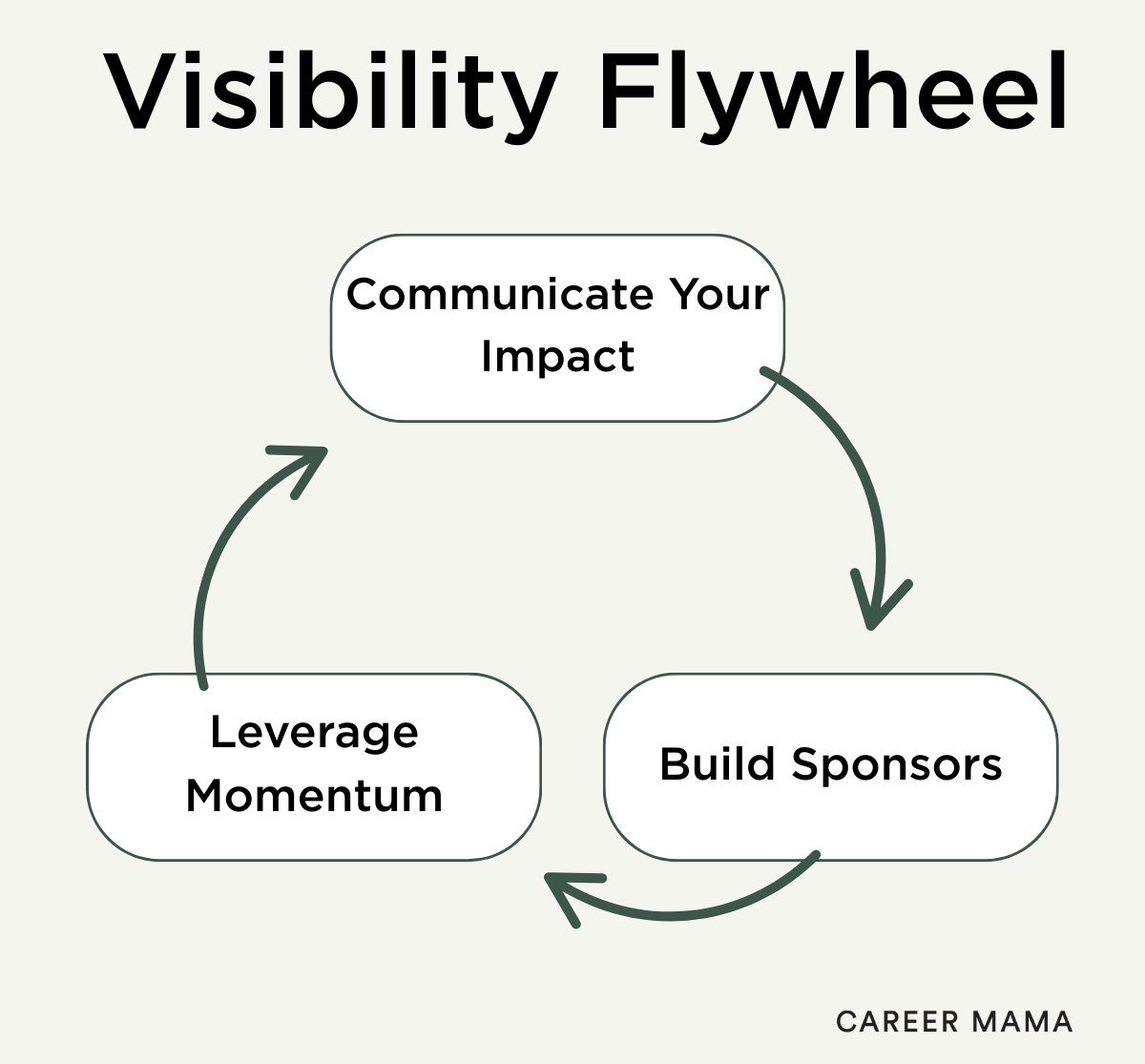
Once I started treating visibility like a system instead of an afterthought, everything changed. I’ve since used that system to coach 5,000+ high-performing women at Fortune 500 companies. I call it the Visibility Flywheel. If you’re doing great work, you can use it to make your impact visible, build sponsors, and turn recognition into opportunity.
This applies to everyone across industries.
The Visibility Flywheel
The Visibility Flywheel has three parts:
Communicate your impact
Build sponsors
Leverage momentum
I’ll describe each part in detail, but first I need to cover a few preliminary points:
First, the Visibility Flywheel works only if you’re low-maintenance—only if your leadership doesn’t think you’re annoying, arrogant, and/or afraid. Leadership wants go-getters who make them look good, not whiners who need to be coddled.
Second, the Visibility Flywheel works only if you’re not quietly collaborating with invisibility. What do I mean by “quietly collaborating with invisibility”? Many high-performers habitually think, feel, and act in ways that make them invisible.
Here are three examples:
They wait until their work is perfect. They want to impress, so they go quiet until there’s a big result. But their silence arouses suspicion instead of building trust.
They make leadership work too hard to understand their impact. They assume good work speaks for itself, so they share lengthy updates loaded with details, screenshots, or busywork. But leadership doesn’t care about everything they did, only cares why it matters, and lengthy updates make leadership work too hard to understand that, so they stop reading.
They speak in ways that minimize their impact. When their manager says, “Great job,” they respond, “It was nothing,” or “I just helped.” They want to look like team players, but downplaying their role teaches stakeholders to devalue their contributions.
Habits like these are like collaborating with the enemy.
They’ll quietly undermine any progress you hope to make with the Visibility Flywheel.
Now that I’ve made these preliminary points, let’s talk about the parts of the Visibility Flywheel in detail.
Flywheel Part 1: Communicate Your Impact
Every message you send should remove friction for your reader.
They should instantly know:
Why it matters
What changed
What you need from them
Most people send updates that either overshare or undershare.
Sharing every step makes you look too tactical, while sharing only wins makes you look self-congratulatory. What’s worse is that both make it hard for leadership to see your real value.
The right kind of sharing displays your judgment and your impact: how you think, what you’re learning, and how you make decisions, and then what happened as a result and why it matters.
To help decide whether to share a piece of work, ask yourself:
Does this tie to our team goals? Share progress that moves the company forward.
Does this solve a problem or show learning? Problems aren’t bad; hiding them is.
Does this connect to my growth areas or strengths? Reinforce what you’re developing or what you’re great at.
Would this matter to my stakeholders? Frame updates around what’s at stake for them.
If you can say yes to any of these, it’s worth sharing.
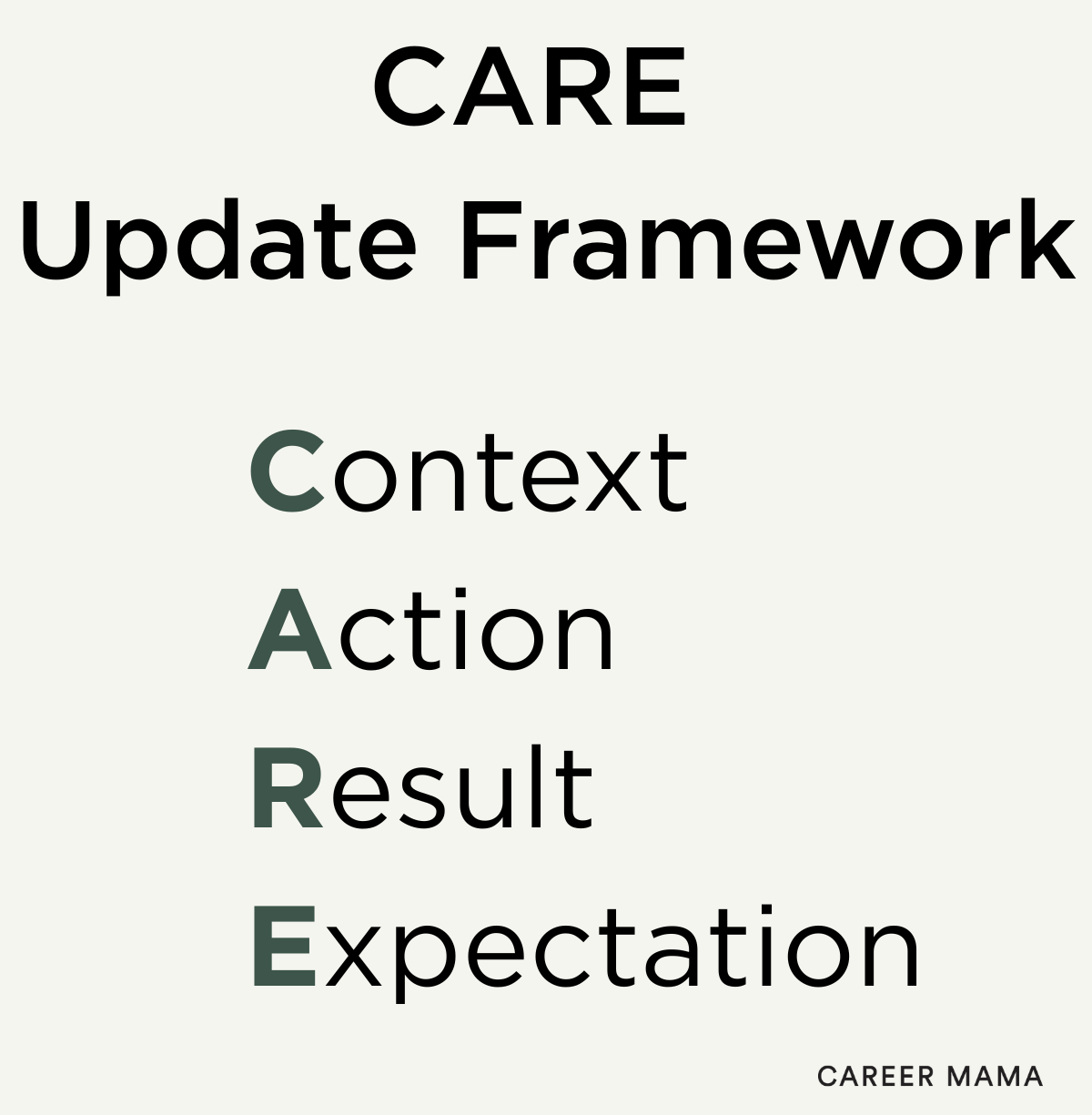
Use the CARE Framework:
Once you determine what’s worth sharing, use the CARE Framework to communicate why stakeholders should care about it:
Context: Tie your update to a goal or risk your stakeholder already cares about.
e.g. “Goal: reduce onboarding time for new engineers this quarter” or “Identified bug that is delaying the campaign launch because of [X]”.
Action: Say what you did, in one sentence.
“We removed two steps that caused the most drop-off.” or “Drafted copy ready for feedback.”
Result: Share movement, even if it’s directional.
“Ramp time dropped by 18% in the pilot.” or “Received approval on resources required to fix bug.”
Expectation: Tell them your ask or what’s next.
“Decision: approve 2 days of design support to ship by Tuesday.” or “No action required.”
That’s it.
Four lines. One screen. Zero confusion.
Examples:
❌ Instead of: “I led a Q2 dashboard cleanup.”
✅ Say: “I identified operational inefficiencies costing us 10 hours a week, and the team reduced inefficiencies because of my findings.”
❌ Instead of: “We’re finalizing the copy with the plan to launch next week.”
✅ Say: “We refined copy to reduce friction. Once design finalizes, we’ll launch next week. If it slips, I’ll prioritize the highest-impact screens first.”
❌ Instead of: “I met with marketing.”
✅ Say: “I worked with marketing to unblock a high-risk dependency and deliver ahead of schedule.”
To help you with this, download these free plug-and-play scripts and templates in the Recognition Toolkit. Anyone can use them for 1:1s and to quickly write emails that explain your impact with clarity and confidence.
Pro tip:
Don’t wait until something is finished to share it.
Every update builds confidence that you’re steering instead of drifting.
People don’t expect perfection. They expect to know what’s happening.
Delivering “Difficult” Updates
Not every update you deliver will be filled with progress. If you get stuck, don’t disappear. Silence communicates confusion or lack of progress. Instead, use questions to show expertise and ownership.
Explain what you’ve tried, what you’ve learned, and where you need input: “Here’s what I’ve done so far, here’s what I’m testing, and here’s where I’d love your perspective.”
Asking for help is normal. Use that normal occurrence to showcase your progress and strategic thinking. For example, “I’m trying to fix this bug, but I still keep getting an error. Here’s what I’ve tried so far [brief summary]. What am I missing? How do you recommend I look into this?” Or: “We launched a similar campaign and received X feedback because of Y. Are you finding similar results?”
When you communicate with clarity and curiosity, people stop seeing you as a mere doer and start seeing you as a strategic operator.
Flywheel Part 2: Build Sponsors
Visibility grows through relationships.
Decisions about whether you get promoted or which projects you work on happen in rooms you’re not in. So you need sponsors who will advocate for you in these conversations—people who have influence and will reinforce your story when you’re not there.
People advocate for those whose impact they see, understand, and trust.
Two things can help build sponsors:
1. Ask for feedback and goals
People help people that make them look good. During the quarter, check-in to see how things are going and how you can better support decision-makers like your manager and skip-level leader. Questions you can ask:
What are you most focused on right now?
What would make you “love” this instead of just “like” it?
What’s one thing that would make this stronger?
2. Share the stage
Publicly thank collaborators. “Thanks to [peer] for pulling the data that saved us two days of rework.” Be genuine. I love giving my working group shoutouts in company Slack channels and All-Hand presentations. Gratitude makes people remember you as generous and effective, and others get the credit they deserve.
For example, I invited a cross-functional partner who’d been resistant to our project to join leadership meetings on our goals. It got him invested since he gained visibility with key stakeholders, and his team earned public shoutouts for turning around tight deadlines.
Flywheel Part 3: Leverage Momentum
Don’t let visibility end at “Good job.”
 | A guest post by
|