

The Hidden Skill Behind Every Successful Leader: Influence Without Authority
A practical 3-step playbook for earning credibility, building momentum, and aligning teams — before the title catches up

Hi, it’s Ethan & Jason from Level Up: Make career breakthroughs with AI-proof leadership skills.
Popular articles you might have missed (or want to revisit):
This edition of Level Up is a guest post from Anusha Dasarakothapalli, a Principal Software Engineer (PE) at Amazon, in the AWS Applied AI Solutions Organization. With over 10 years of industry experience, she specializes in distributed systems, large-scale data platforms, and agentic AI infrastructure. She consistently leads cross-organizational initiatives that shape system architecture and engineering strategy across critical businesses in AWS, spanning anywhere from 20 to 500 engineers.
Her work as a PE sits at the intersection of technical depth and organizational influence, where driving impact often requires leading without authority.
In this article, Anusha shares her practical 3-step playbook for influencing without authority: earn credibility, articulate value, and drive alignment before key decisions. She also explains how to use AI to “show, not tell” by turning ideas into working prototypes that reduce uncertainty and accelerate support.
Use her playbook to expand your influence and lead at greater scale (without waiting for formal authority).
The most common misconception in professional growth is that leadership is a function of headcount.
Many ambitious professionals wait for a “Manager” or “Director” title before they feel empowered to drive large-scale change.
This is the Authority Trap: waiting for a promotion to lead, when leading is actually the prerequisite for the promotion.
In today’s matrixed organizations across companies, the most critical work happens between the boxes on the org chart. Success depends on your ability to influence peers, stakeholders, and partner teams who have no structural reason to say yes to you. Influence is not a byproduct of your title; it is a byproduct of the trust you’ve built and your ability to reduce risk for others.
At Amazon, one of the most critical roles for me as a Principal Engineer (PE) is being able to influence without authority. PEs are held fundamentally accountable for the architectural integrity and long-term success of massive systems. If these systems fail or miss a critical innovation window, the responsibility (albeit indirectly) often rests with the PE.
However, on the official org chart, a PE typically has a team of zero. To execute a cross-cutting initiative, we must be able to successfully convince teams that don’t report to us, sometimes three levels deep in another VP’s organization. If we attempt to lead by rank, we fail.
We instead need to succeed at making our vision the most logical, data-backed path forward for everyone involved.
I learned how to do this the hard way.
A couple of years ago, I was tasked with shepherding a critical initiative tied to the launch of new AWS regions across my VP’s organization, which spanned businesses owned by 7 Directors/General Managers and 450+ engineers. Everyone was on the same page about how critical this work was.
However, I joined the organization as a PE after roadmap planning had already been completed during a period of global headcount crunch. Every team was already over-indexed on existing commitments.
Initially, I followed what I considered a standard script to try to get this work resourced. I authored a comprehensive strategy document (backed by data of course), and requested a 5% headcount allocation from the teams to staff the effort.
The result was immediate gridlock!
Despite the clear long-term benefits, the teams viewed this as a tax imposed from the outside, especially after the planning cycle was already over. To them, I was someone with no direct authority asking them to give up their already committed roadmaps.
To move forward, I had to do something different: earn the trust of these teams by pivoting from a top-down mandate to a bottom-up strategy.
Instead of continuing to debate this at the VP level, I went to the trenches.
I spent the next few weeks meeting with the engineers who managed the day-to-day software. I organized mini offsites with a cohort of engineers from all teams, and asked about their “paper cuts” — the small, recurring issues that individually seem minor but collectively create significant friction in day-to-day work. What was making their on-call rotations miserable? Where was the manual toil hidden that doesn’t get prioritized?
Through these conversations, we surfaced a clear set of manual bottlenecks tied to the initiative and identified a group of engineers who were genuinely invested and passionate about fixing them. I brought this cohort together in a shared Slack channel, along with engineers from adjacent VP orgs working on a similar initiative.
Through the course of the project later on, this channel became the backbone for momentum. We shared quick wins everyday, connected related efforts across teams, and helped surface and eliminate redundant work across these teams.
By the time the updated proposal was presented to my VP again, it wasn’t “my” plan anymore. It was a collection of solutions to the engineers’ own problems tied to the larger strategic initiative that mattered to the business. Because I understood the technical debt of each service a lot better this time, I could work with them to help identify exactly what could be deferred to make room for automation. We presented a “this is possible” plan to leadership that was proposed and vetted by the engineers who owned and operated the lines of code. And yes, we achieved the goal that year too!
While the PE role is a specific extreme, the mechanics of non-positional leadership are universal. For example, product managers are expected to influence engineering teams without being their boss. Marketing leads are expected to influence product design without owning the roadmap. And, everyday, individual contributors are expected to influence their managers and other engineering peers on their team to pivot strategy.
The ceiling on your career is often not about your technical skill alone; it is also about your ability to scale yourself by driving results through people whose roadmap you do not directly control.
To break through this ceiling, you must master the mechanics of technical and social alignment.
How AI is Changing the Ability to Influence Without Authority
The rise of AI is quietly reshaping what it means to influence without authority. It is lowering the barrier to execution while raising the bar for leadership.
In the past, influencing without authority often meant convincing others to invest time and resources into an idea before any tangible progress could be demonstrated.
Today, with AI-assisted development, the cost of building, prototyping, and validating ideas has dropped significantly. Engineers can now go from concept to working prototype in a fraction of the time it used to take.
The most effective way to influence today is to show, not just tell. A working prototype, even if incomplete, carries far more weight than a polished proposal because it reduces uncertainty and makes the path forward concrete.
At the same time, AI is also contributing to an increasing volume of ideas and potential solutions within an organization. Influence in this landscape, therefore, shifts from simply generating ideas to curating the right ones, aligning them with real problems, and driving them to execution across teams.
Looking back at the initiative I described earlier, I would approach it differently today with the AI leverage I have access to. First, I would use AI to quickly deep dive into one team’s system and workflows, instead of relying solely on hours of SME conversations to uncover optimization opportunities.
Once initial pain points are identified (through offsites or direct engagement), AI can help accelerate my understanding and pinpoint where the highest-leverage fixes lie. This helps me build a much deeper understanding of the systems, and helps me apply my judgement and experience better on what opportunities to prioritize.
Then, I would implement 1 or 2 of those fixes myself, either automating or simplifying a few of the most painful bottlenecks, and validate them in a team’s workflow. From there, I would work with the other teams to identify similar patterns across services to scale that fix across multiple teams.
Finally, when bringing this back to leadership, the strategy would not just describe what should be done, but include what is already working.
A section grounded in observed impact now makes the proposal far more compelling because it shifts the conversation from possibility to execution. What “good” looks like here is not completeness, but clarity: a concrete example that demonstrates the problem, shows how a solution works in practice, and provides early evidence of impact with a clear path to scale.
With AI, much of this can now be done in days instead of weeks, and without pulling significant time from already constrained teams or requiring heavy upfront involvement from subject matter experts. And when presenting a strategy, the conversation is not about a theoretical possibility, but instead “We know this works, how do we execute and scale this?”.
A Playbook for Influencing Without Authority
Through my experience influencing without authority at Amazon and observing other high performing leaders around me excel at this for over a decade, I have found that it is not an abstract trait, but a repeatable skill set after all.
And over time, I have built myself a simple 3-step playbook to do this well.
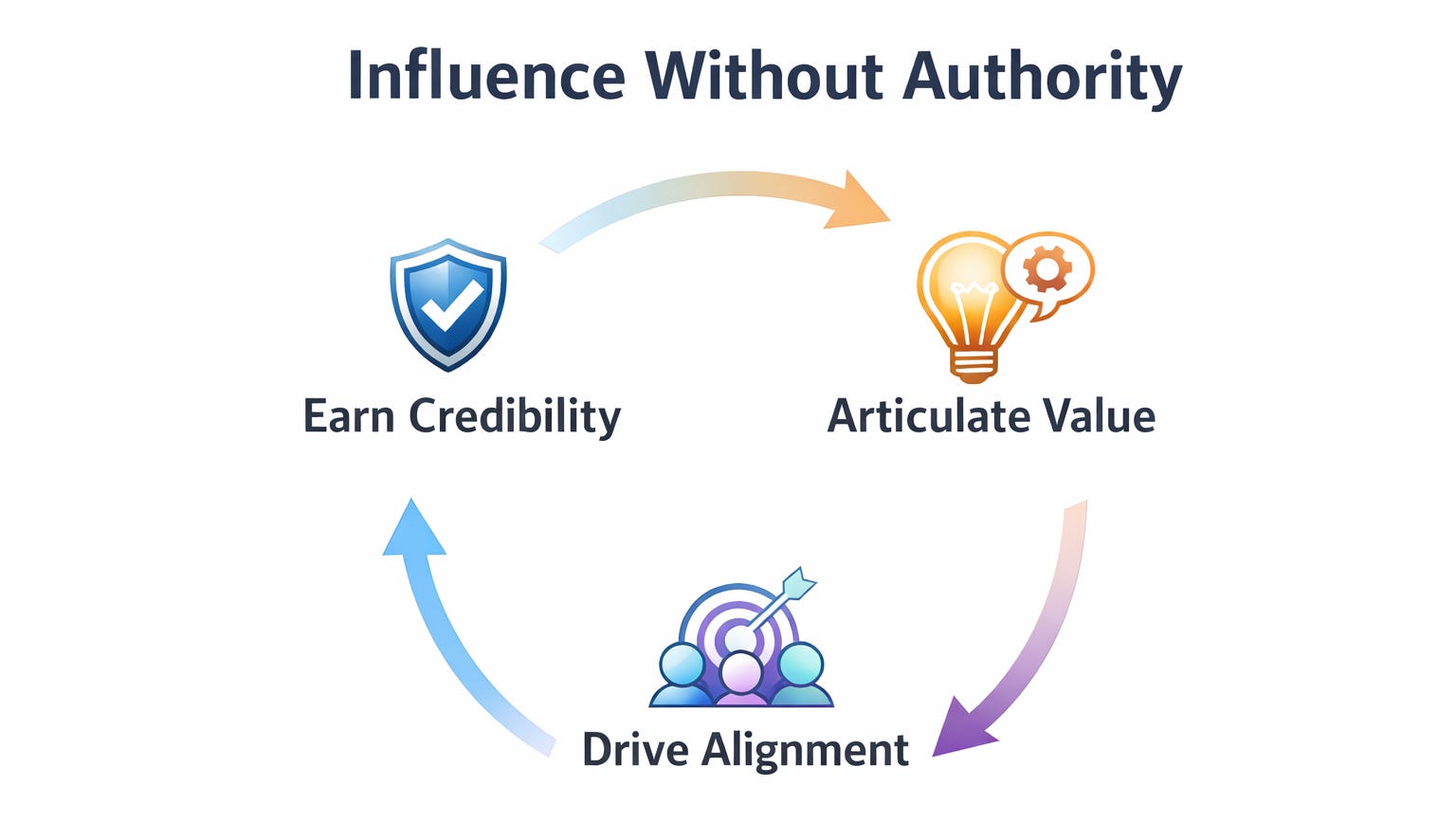
Step 1: Earn credibility with the teams you want to influence
To influence an organization of any meaningful size, even a team of ten, you need to understand the realities of how work actually gets done. High-level strategy alone rarely changes behavior.
What builds credibility is demonstrating that you understand the constraints, trade-offs, and pressures people operate under every day.
In my earlier example, broad narratives about what “the organization cares about” didn’t create momentum. What did was uncovering the day-to-day friction teams or customers experienced and tying the initiative directly to solving those problems.
Earning that level of credibility requires deliberate effort.
Here are some ways you can do this:
a. Start with how the work actually happens, not the org chart.
Trace workflows end-to-end; how a feature gets built, how systems operate, how a customer issue is handled, or how a decision moves through the organization. This grounds your understanding in reality rather than abstraction. AI can accelerate this by helping you quickly synthesize large amounts of information (documents, code, user feedback, or operational data) so you can form a working understanding in accelerated time.
b. Get close to real problems.
Observe or participate in the actual work. For engineers, this may mean debugging code or working through a deployment cycle. For product managers, this can be analyzing user journeys and feedback. And for business leaders, this may involve reviewing decision bottlenecks or operational metrics on a regular basis. Look for recurring friction, delays, and workarounds as these are often the highest-leverage entry points into bigger opportunities waiting to be solved.
c. Turn understanding into small contributions.
Act on what you learn. Fix a small issue, clarify a workflow, improve a decision process, or unblock a team. Even modest contributions signal that you’re not just analyzing the system, but are actively working on improving it. Again, AI is really making this step significantly easier than it used to be earlier.
At this stage, your goal is not to propose big solutions. It is to become someone others and yourself can trust to understand the problem space well enough.
Step 2: Replace authority with value that pulls people in
Once you’ve built trust by understanding the problem space, the next step is to turn that understanding into something others can act on.
This is where many people fall into what I call the “Authority Trap”: the belief that progress requires formal ownership or a title.
In reality, influence at this stage doesn’t come from asking for permission or directing work. It comes from consistently making it easier for others to achieve outcomes that matter. When you do this well, people don’t just comply with your ideas, they actively choose to engage with them.
This requires a shift from a “command” mindset to a “service” mindset.
Instead of focusing on how to get others to execute your plan, you focus on how to reduce friction, clarify direction, and create momentum for the teams involved.
When your presence consistently leads to progress, people naturally begin to look to you for direction, regardless of your position in the org chart.
In practice, this comes down to a few deliberate behaviors:
i. Frame the problem in terms of outcomes that matter.
Clearly articulate what is broken, who it impacts, and why it matters now. More importantly, connect it to what each stakeholder or your customers care about; whether that’s reliability, user experience, cost, speed, or revenue. The stronger the connection to real outcomes, the easier it is for others to prioritize it.
ii. Break the work into adoptable pieces.
Large, abstract initiatives are hard to act on. Decompose the problem into smaller, clearly scoped pieces that teams can realistically take on without disrupting their priorities. This is where your understanding from Step 1 becomes critical. Your goal here is to shape work in a way that fits into how teams already operate.
iii. Make value tangible early.
Don’t rely on a polished proposal to build momentum. Show progress. This could be a prototype, a mockup, a small fix, or an experiment that demonstrates impact. With the progress of Generative AI, there has never been an easier time in history to do this. Use it to help you quickly build or simulate solutions, turning ideas into something concrete that others can react to.
iiii. Share the execution load.
Don’t just define the work, actually help move it forward. Where possible, assign yourself as the owner of some of those pieces you broke up in your proposal. Whether it’s contributing directly, coordinating across teams, or unblocking dependencies, your involvement signals that you are invested in outcomes, not just ideas.
Over time, these behaviors create a pattern.
People begin to associate your involvement with clarity and progress rather than additional overhead. At that point, influence becomes less about persuasion and more about trust, because your work consistently makes things better for the people around you.
Creating this kind of value builds momentum with the teams you want to influence. They start engaging, contributing, and even advocating for the work.
But momentum alone doesn’t guarantee outcomes, especially in larger organizations where decisions involve multiple stakeholders with different priorities.
At some point, that momentum needs to translate into alignment. Without it, even strong ideas with visible progress can stall or get blocked at key decision points.
This is where the last step in our influence journey comes in: from creating value to sourcing alignment with the right stakeholders.
Step 3 - Orchestrate alignment before big decision points
One of the most common misconceptions in cross-team work is assuming that alignment happens in large forums such as VP reviews, steering committees, or executive discussions.
In reality, those meetings rarely create alignment; they confirm and communicate it. If you are hearing major objections for the first time in those settings, you’ve already missed the opportunity to shape the outcome.
 | A guest post by
|