

From Executive Absence to Executive Presence
4 EQ Skills That Changed Everything

Hi, it’s Ethan & Jason from Level Up: Make career breakthroughs with AI-proof leadership skills.
We have two upcoming talks, RSVP below:
(June 27) The Executive Presence Masterclass. State your impact clearly, handle tough executive questions, and stop letting your work go unnoticed.
(July 15) Top of Mind: Two Thoughts + AMA with Ethan. Get an inside look at what Ethan is evaluating, followed by Q&A. Exclusive to Level Up Members.
This edition of Level Up is a follow-up guest post from Rich Hua, Founder and Chief EQ Officer of EPIQ Leadership Group, which works with leaders to harmonize their EQ and IQ (EPIQ). As Chief EQ Evangelist and Worldwide Head at Amazon, he built and scaled the largest corporate-based EQ community in the world, reaching 1.5 million people. He is a global keynote speaker, transformation architect, and advisor to Fortune 100 companies on leadership, emotional intelligence, and building cultures of innovation at scale.
In this article, Rich shares in-depth techniques you can apply immediately to enhance your self-awareness, self-management, social awareness, and relationship management to build your executive presence.
To go deeper, enroll in his upcoming EQ course to boost your adaptability, resilience, and performance as a leader or senior IC.
And get weekly advice at Rich’s EPIQ Success Newsletter.
Everyone wants executive presence.
Almost nobody talks about the word hiding inside it: presence.
Think about the last meeting you were in.
Were you fully there?
Or were you half-listening while scanning a Slack notification, mentally drafting your response to an email, and wondering what your friend just texted you about?
Be honest.
You’re not alone.
Research shows that the average adult can only sustain attention on a single task for about 47 seconds before switching. 79% of employees can’t go a full hour without getting distracted.
Our brains are like squirrels watching acorns fall from a tree on a windy day.
We are almost never fully present.
Now consider what we’re really asking for when we say “executive presence.”
This semi-mysterious quality is generally defined as the ability to garner respect, inspire confidence, and exert influence. It is characterized by gravitas (confidence and poise under pressure), strong communication, and an authentic and professional demeanor.
We want to walk into a high-stakes situation and be so focused, so attuned, so emotionally locked in that we command attention and earn trust.
But if we can’t sustain presence in an ordinary Tuesday afternoon meeting, what makes us think we can summon it when the VP asks a question we didn’t see coming?
Amy Cuddy, the Harvard psychologist best known for her research on body language, wrote an entire book on this called Presence.
Her definition resonated with me: presence is the state of being attuned to and able to comfortably express our true thoughts, feelings, values, and potential.
Not performing.
Not projecting.
Being attuned.
Cuddy’s research (with Susan Fiske and Peter Glick) also found that when people evaluate you, they assess warmth before competence—often within milliseconds.
Warmth answers the question, “Can I trust you?”, and competence answers, “Can I respect you?”
Warmth wins in both personal and professional interactions.
Warmth carries more weight because knowing someone’s intentions matters more than knowing their capabilities.
This is why so many sharp leaders with strong arguments fail to create larger impacts: they lead with competence but skip trust.
Knowing this might reframe executive presence entirely.
Presence is not a personality trait or ability you’re born with.
It’s a state you enter.
And the skills that usher you into that state—especially under pressure—are emotional intelligence skills, they include:
Self-awareness to know what’s happening inside of you.
Self-management to project calm (which reads as warmth, not weakness).
Social awareness to read what others need.
Relationship management to build trust in real time.
Executive presence is just presence deployed in high-stakes environments. If you can’t be fully present with your team during your weekly meeting, you won’t magically find it when you’re presenting to the C-suite.
I know this because I spent the first part of my career without it.
I had what I now jokingly call executive absence.
Sharp technical mind, solid arguments, and right answers, but I’d walk into a room with senior leaders and have minimal impact.
I’d talk too fast when I got nervous.
I’d get defensive when challenged instead of offering a thoughtful reply.
I’d focus so hard on making my point that I forgot to connect with the people in the room.
I eventually developed the critical EQ skills that became the foundation of my executive presence. I’ve shared these skills with hundreds of thousands of people at Amazon and Fortune 500 companies.
Here are four that made a big difference.
1. Self-Awareness: Know What’s Happening Inside You Before It Leaks Out
Here’s a number that might surprise you: Tasha Eurich, an organizational psychologist, found that 85% of people believe they are self-aware…but only about 15% actually are. That gap shows up in every meeting where a leader thinks they’re projecting calm but everyone else sees anxiety or frustration.
Self-awareness in high-stakes moments means knowing your emotional state and how it’s shaping your thinking and behavior in real time.
It means catching yourself before your nerves take over.
When I was preparing to present the EPIC Leadership proposal to my VP and his leadership team at Amazon, I had to get honest with myself.
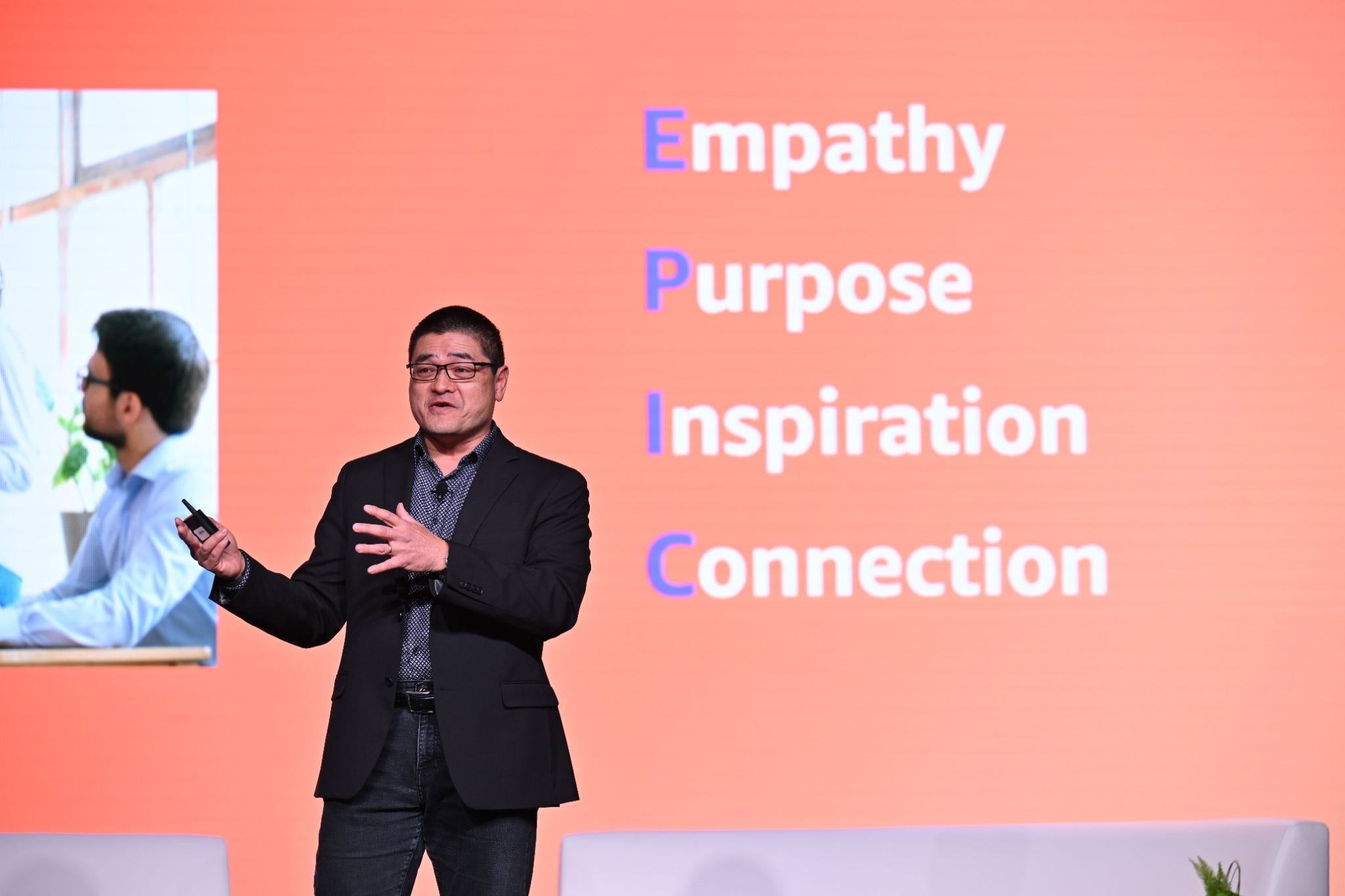
EPIC (which stood for empathy, purpose, inspiration, connection) was my initiative to develop emotional intelligence in leaders at Amazon and at AWS customers.
Nothing like it had ever been attempted.
I was walking away from a high-visibility role as a Principal on Aurora PostgreSQL (the fastest-growing service in AWS history at the time) to do something that most people in a data-driven culture would view with skepticism.
My presentation would follow Amazon’s famous six-page narrative process: everyone would silently read my document for the first 25 minutes and then engage in a rigorous, high-energy discussion to challenge ideas, ask tough questions, raise concerns, and pressure-test the thinking.
Before I even walked into that room, I had to ask myself some important questions:
What am I feeling right now? (Excited, but also nervous that this proposal could be shot down.)
How will those feelings show up if I don’t manage them? (I’ll oversell. I’ll get defensive when someone pokes a hole in my plan.)
And what is the room going to be thinking that nobody will say out loud? (This sounds nice, but how does it actually drive business results?)
I knew the skepticism would center on ROI.
I had feedback from EQ sessions, reach numbers, anecdotes, and glowing customer testimonials. What I didn’t have was airtight data proving business impact.
I was, in some ways, asking my VP to take a gamble.
Self-awareness didn’t make the gap disappear, but it let me walk in with a clear picture of where my argument was strong, where the risks were, and a plan for how to handle each.
Self-awareness techniques:
Check in with yourself before high-stakes moments. What emotions am I experiencing? Name the emotion. As the saying goes: if you can name it, you can tame it. An excellent tool to increase your emotional awareness is the How We Feel app developed by Dr. Marc Brackett (Yale Center for Emotional Intelligence) and Ben Silberman (founder of Pinterest). Download it for free at howwefeel.org.
Do a two-minute power pose before you walk in. Amy Cuddy’s research found that standing in an expansive, high-power posture for just two minutes increases confidence. I use this myself all the time, especially before high-stakes meetings, I stand tall, hands on hips or arms wide, and let my physiology shift my psychology. It sounds simple, but it works.
Visualize how you’ll handle the challenging moments. Don’t just rehearse your content—rehearse your composure. Picture yourself getting asked the question you’re most afraid of. Then visualize not just what you’ll say, but how you’ll say it: the pause before you answer, the steady tone, the calm body language. Elite athletes visualize performance under pressure. Leaders should too.
2. Self-Management: Calm Under Pressure Is a Superpower
If self-awareness is knowing what’s happening inside you, self-management is doing something about it. When you are calm, you think clearly. When you think clearly, you respond with more competence, authority, and warmth. When you do that under pressure, that’s gravitas.
It’s all a chain reaction that starts with calm.
Here’s what most people don’t know: stress doesn’t just make you uncomfortable. It makes you measurably dumber.
Research shows that cognitive performance can drop by 50% or more under acute pressure—unless you have emotion skills to regulate it. When cortisol floods your body, it degrades function in your prefrontal cortex, the part of your brain responsible for working memory, complex reasoning, and decision-making. The very cognitive tools you need most in a high-stakes moment are the first ones to go offline when you’re stressed out.
How much does regulation actually help? Research was done with Australian Special Forces soldiers, where a group of soldiers was given emotional intelligence training (specifically around emotion regulation), and then their cognitive performance was compared against an untrained control group under intense stress conditions.
The results were astonishing.
The untrained soldiers did 45% worse than the trained soldiers in a high-stress “shoot-no-shoot” drill, recalled 40% fewer details from an operational radio report, and did complex math problems with 66% less accuracy. (They also had 72% less pain tolerance, which is a big deal for a bunch of elite commandos.)
The untrained soldiers were literally “dumber” than the EQ-trained ones under stress.
The difference: the trained soldiers learned to calm their nervous system before it hijacked them. That kept their minds clearer and sharper under pressure.
The leaders who have executive presence aren’t the ones who feel no stress.
They’re the ones who regulate it before it hijacks their brain.
Back to the EPIC doc read at Amazon.
I’m there on a video conference call with my VP and his leadership team.
They’ve read my doc, and the biggest question lands exactly where I expected: “How do these skills drive business results?”
The temptation was to oversell or hedge.
Instead, I had regulated my nervous system before the meeting.
I paused before answering.
I stated what the data showed, was honest about the gaps, and communicated conviction about the possibility.
I didn’t hedge and I didn’t oversell.
I asked them to take a gamble with me.
They said yes.
That meeting was the beginning of what became the largest corporate EQ initiative in the world.
My argument certainly wasn’t flawless, but I did offer compelling data, and I was calm enough to discuss it with clarity and conviction.
Self-Management techniques:
Go BIG before you go in. BIG stands for Breathe, Intention, Gratitude. Take a few deep breaths. Then set your intention—not just what you want to say, but how you want to show up. (Calm? Convicted? Curious?) Then find something to be genuinely grateful for. It could be the opportunity, your colleagues, or the potential impact. Gratitude shifts your brain from threat mode to opportunity mode. This takes two minutes and it fundamentally changes the state you walk in with.
Practice resonant frequency breathing. This was one of the main techniques taught to Australian Special Forces soldiers in the above-mentioned study. The target is a 4-6 rhythm: inhale smoothly through your nose for 4 seconds, exhale softly through your mouth (like blowing through a straw) for 6 seconds. That’s a 10-second cycle, 6 breaths per minute. It’s the optimal rate to activate your vagus nerve and reduce cortisol levels. Five minutes of this before a big meeting can measurably sharpen your thinking.
Use a mental model when the pressure hits. Top performers (pilots, FBI agents, surgeons, executives) don’t emotionally react under stress; instead, they use mental models to manage their response. A mental model is a pre-internalized framework that shapes how you interpret situations. When interacting with others, some helpful ones are: “strong disagreement does not necessarily mean bad intent,” “resistance usually signals fear, uncertainty, or lack of clarity,” and “the person who stays curious longest often sees most clearly.”
3. Social Awareness: Read the Room and Adapt in Real Time
If calm is the internal game of executive presence, then empathy is the external one.
Social awareness is what separates leaders who deliver information from leaders who move people. It’s the ability to pick up on what others are thinking and feeling, what they need, and what’s going unsaid.
Many professionals treat empathy as a nice-to-have soft skill.
It’s not.
Empathy is what tells you what will resonate with your audience and how to convey it in a compelling way.
Without it, you’re guessing.
With it, every message you deliver has a better chance of landing because you’ve already mapped the terrain: their goals, values, strengths, and pains.
Everyone has things in all those buckets.
The more you understand, the more influence you’ll have.
This is empathy in action.
It’s going beyond “I understand how you feel” to actively using that understanding to shape how you communicate, what you emphasize, and what you leave unsaid.
It’s empathy deployed as a strategic capability.
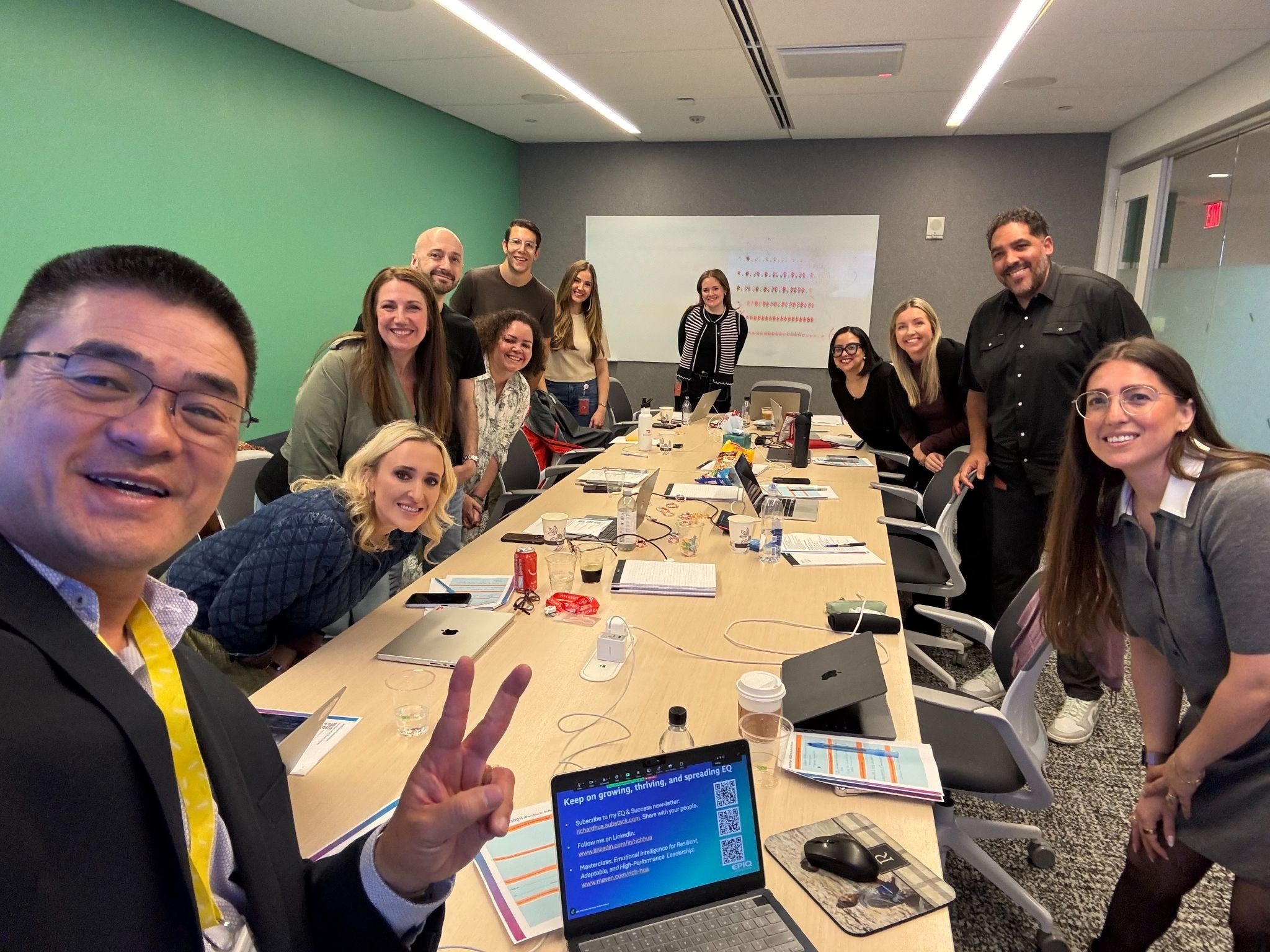
I learned this during a session with the global CTO and leadership team of a large healthcare and life sciences company.
I had been asked to deliver a one-hour talk on EQ for innovation.
She wanted her team to adopt new ways of working: more adaptability, greater collaboration, and more productive conflict.
Their culture was too “nice,” and she wanted to mix things up to spur more innovation.
I was excited but a bit uncertain.
I had never met this CTO, and I wasn’t totally sure what to expect from the team.
But I believed my message would benefit them, and I delivered my presentation with my usual energy and curiosity.
About 45 minutes in, she stopped me…
 | A guest post by
|